


Behavioral AI - IA conductual

What Is Relationship Intelligence?
A diferencia de los sistemas de IA tradicionales que se basan principalmente en datos estáticos, reglas predefinidas o promedios históricos, la IA conductual analiza las señales de comportamiento, como las acciones, los patrones, el contexto y los cambios a lo largo del tiempo.
a transaction, a payment, a credit application, a fraud alert. Each event wasevaluated separately, often through rule-based models or static risk scoringframeworks.Relationship intelligence shifts theperspective. Instead of analyzing isolated actions, institutions analyzepatterns of interaction across time, channels, and financial contexts.In this model, the relationshipitself becomes the primary unit of analysis.Every action — from spendingbehavior to repayment timing, digital engagement patterns, and response tofinancial stress — contributes to a continuously evolving understanding of thecustomer
En los servicios financieros, la IA conductual se utiliza para pasar de decisiones únicas a una toma de decisiones adaptativa basada en las relaciones.
Why Relationship Intelligence Matters Now
Several structural changes infinancial services make relationship intelligence increasingly important.
Digital financial ecosystems
- Customers now interact withfinancial institutions through multiple channels: mobile banking, embeddedfinance platforms, payment ecosystems, and digital lending environments.
- These interactions generatebehavioral signals that extend far beyond traditional credit bureau data.
Fragmented financial behavior
- Customers often hold accounts acrossmultiple institutions and services.
- Static customer profiles fail to capture how individuals manage liquidity, risk tolerance, and financial prioritiesacross contexts.
- Relationship intelligence enablesinstitutions to detect patterns that emerge only when behavior is observed overtime.
Earlysignals of risk and opportunity
- Financial stress rarely appearssuddenly. It emerges gradually through subtle behavioral shifts: changes inpayment timing, spending volatility, reduced engagement, or increased relianceon credit.
- Systems designed to evaluateisolated transactions often miss these early indicators.
Transitionfrom product-driven to relationship-driven models
- Historically, financial institutionsoptimized around products: loans, accounts, cards, and investments.
- Modern financial ecosystemsincreasingly optimize around relationships — long-term engagement, trust, andlifecycle value.
- Relationship intelligence providesthe analytical layer necessary to support this shift.
Relationship Intelligence provide you with the motivators of your customer that are needed in every interaction
How Relationship Intelligence Works
Conceptually, relationshipintelligence operates through three analytical layers.
Longitudinal Behavioral Analysis
En realidad:
- La personalización se basa en segmentos, no en individuos
- Engagement intensity within digital channels
- Changes in transaction regularity
These patterns reveal behavioral trajectories rather than isolated data points.
Adaptive Relationship Modeling
The relationship between aninstitution and a customer evolves over time.
Adaptive models continuously updatetheir understanding of:
- El comportamiento de los clientes cambia constantemente
- El riesgo es dinámico, no estático
- La confianza, la intención y la vulnerabilidad cambian con el tiempo
Rather than recalculating scoresperiodically, the system maintains an ongoing relationship model.
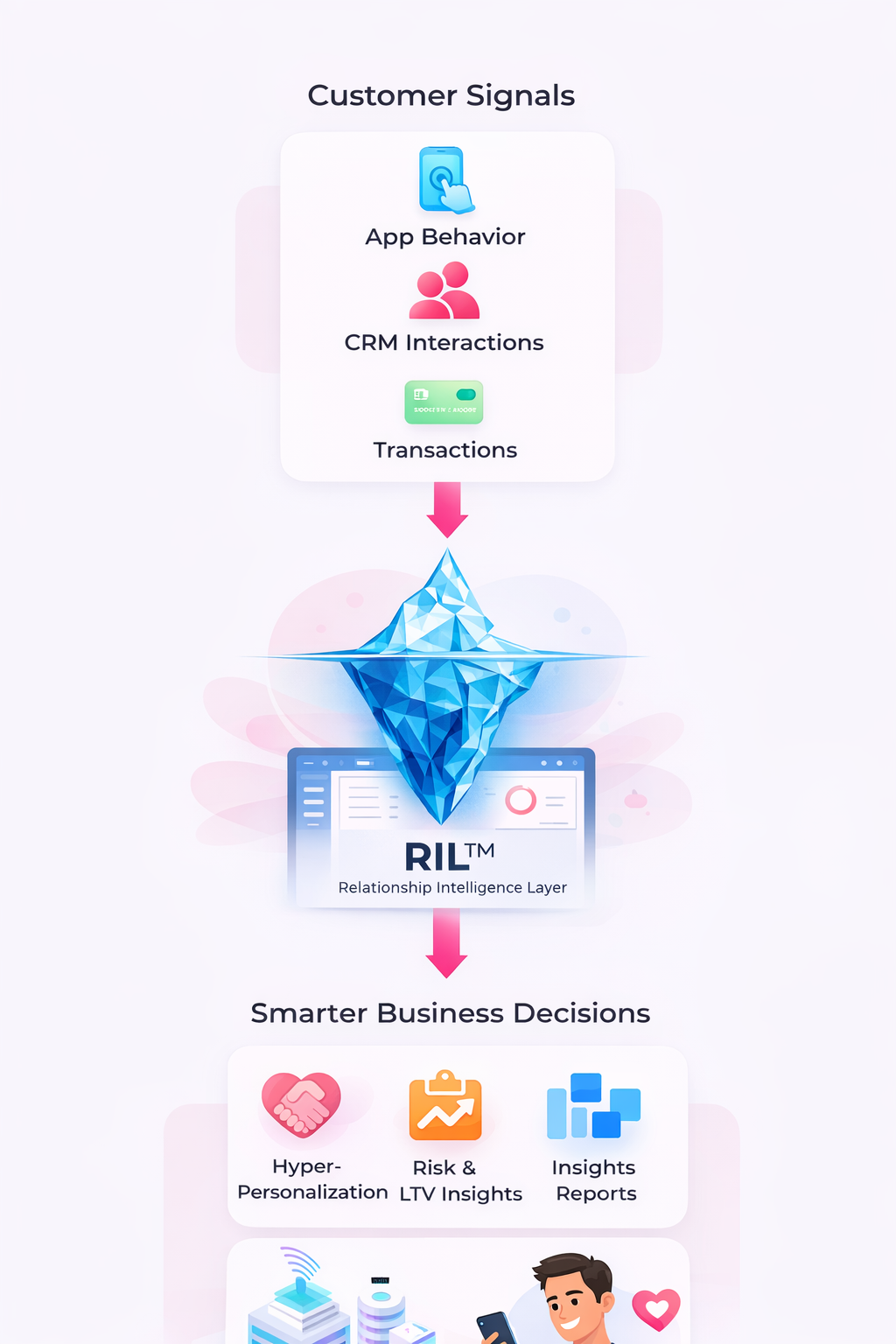
Contextual Interpretation
Los servicios financieros que priorizan lo digital, los pagos en tiempo real y las interacciones impulsadas por la IA han hecho visibles estas brechas.
La IA conductual es importante ahora porque permite a las instituciones financieras:
- Increased spending may signal financial stress in one context, and normal seasonal activity in another.
- Reduced engagement may reflect satisfaction for one customer and disengagement for another.
- Trust, intent, and vulnerability shift over time
Relationship intelligenceincorporates contextual variables such as timing, historical patterns, andcustomer lifecycle stage.
- Reacciona ante el comportamiento a medida que ocurre
- Detecte las señales de manera temprana antes de que los problemas se agraven
- Construya relaciones continuas en lugar de decisiones únicas
Dónde fallan los sistemas tradicionales

Los sistemas financieros tradicionales son en su mayoría transaccionales y basados en reglas.
Entre las limitaciones comunes se incluyen las siguientes:
Transaction-centricarchitecture
- Modelos de riesgo estáticos que se actualizan lentamente
- Motores de reglas que no pueden adaptarse a un nuevo comportamiento
Siloed decision environments
- Señales tempranas de estrés financiero
- Cambios sutiles de comportamiento que indican riesgo u oportunidad
- Contexto detrás de las acciones de los usuarios
Static riskframeworks
- Reacciona de forma exagerada y bloquea a los usuarios legítimos
- Reacciona de forma insuficiente y pasa por alto el riesgo real
Limitedbehavioral interpretation
- Raw behavioral data is frequentlyavailable but underutilized.
- Without behavioral modelingframeworks, institutions struggle to convert signals into actionable insights.
The Role ofBehavioral AI
Relationship Intelignence depends heavily on behavioral interpretation.
Esto hace que la IA conductual sea más adecuada para entornos complejos impulsados por humanos, como los servicios financieros.
Customers do not follow static patterns.
Context and change are critical.This is where Behavioral AI becomes foundational.Behavioral AI enables systems tointerpret how actions fit within a broader behavioral trajectory.
Instead of evaluating isolatedevents, behavioral models analyze patterns such as:
- Aprendizaje continuo en lugar de actualizaciones periódicas
- Patrones de comportamiento en lugar de características estáticas
- Decisiones que tengan en cuenta el contexto en lugar de resultados basados en reglas
- Interaction consistency across channels
A deeper explanation of thisbehavioral infrastructure is explored in our overview of Behavioral AI infinancial services.Relationship intelligence builds onthis layer by applying behavioral understanding across the entire lifecycle ofthe customer relationship.

Relationship Intelligence and Hyper-Personalization
La IA conductual no se basa en un solo punto de datos o puntuación. Funciona mediante el análisis continuo del comportamiento a lo largo del tiempo.hyper-personalization in financial services.While hyper-personalization focuseson adapting offers and decisions at the individual level, relationship intelligence provides the longitudinal context necessary to support thoseadaptations. Without understanding the trajectoryof a relationship, personalization risks becoming reactive rather thanstrategic.
El resultado es una toma de decisiones que se adapta de forma dinámica, en lugar de basarse en suposiciones fijas.Hyper-Personalizationin Financial Services.Together, these capabilities enableinstitutions to move beyond reactive systems toward adaptiverelationship-driven architectures.
Casos de uso clave de la IA conductual en los servicios financieros
La IA conductual puede respaldar una amplia gama de casos de uso financiero, que incluyen:
Toma de decisiones crediticias
.svg)
Evaluación dinámica del comportamiento del prestatario
Detección temprana del estrés financiero
Decisiones crediticias más precisas y justas
Credit Strategy
Identificación de patrones de comportamiento inusuales
Detección de señales sutiles de fraude ignoradas por las reglas
Reducción de falsos positivos
Customer Engagement
Adaptación en tiempo real de ofertas y mensajes
Personalización basada en el comportamiento, no en la demografía
Mejor compromiso y conversión
Protección al cliente
Detección de usuarios vulnerables o en riesgo
Prevención de acciones financieras perjudiciales
OrganizationalImplications
La IA conductual representa un cambio en la forma en que los sistemas financieros entienden y responden al comportamiento humano.
- Decisiones más inteligentes
- Mejor gestión de riesgos
- Relaciones más sólidas con los clientes
A medida que los servicios financieros siguen evolucionando, la IA conductual proporciona la base para sistemas que son adaptables, responsables e impulsados por las relaciones.
Preguntas frecuentes (FAQ)

Traditional CRM systems track interactions and communication history. Relationship intelligence analyzes behavioral patterns to interpret how financial relationships evolve over time.
No necesariamente. Complementa y mejora los modelos existentes al agregar un contexto conductual y conocimientos en tiempo real.
No. Cualquier organización que interactúe con los usuarios a lo largo del tiempo puede beneficiarse de comprender el comportamiento de forma dinámica.
Al reducir la fricción innecesaria, mejorar la personalización y tomar decisiones que reflejen el comportamiento real de los usuarios en lugar de reglas rígidas.
TheStrategic Shift
Financial systems historicallyoptimized for transactions.
Modern financial ecosystemsincreasingly optimize for relationships.
- Relationship intelligence representsthe analytical framework required to understand those relationships as dynamicsystems rather than static profiles.
- Institutions that adopt thisapproach move beyond reacting to events and begin to anticipate the evolutionof financial behavior.
- This shift will define the nextgeneration of financial decision systems.